
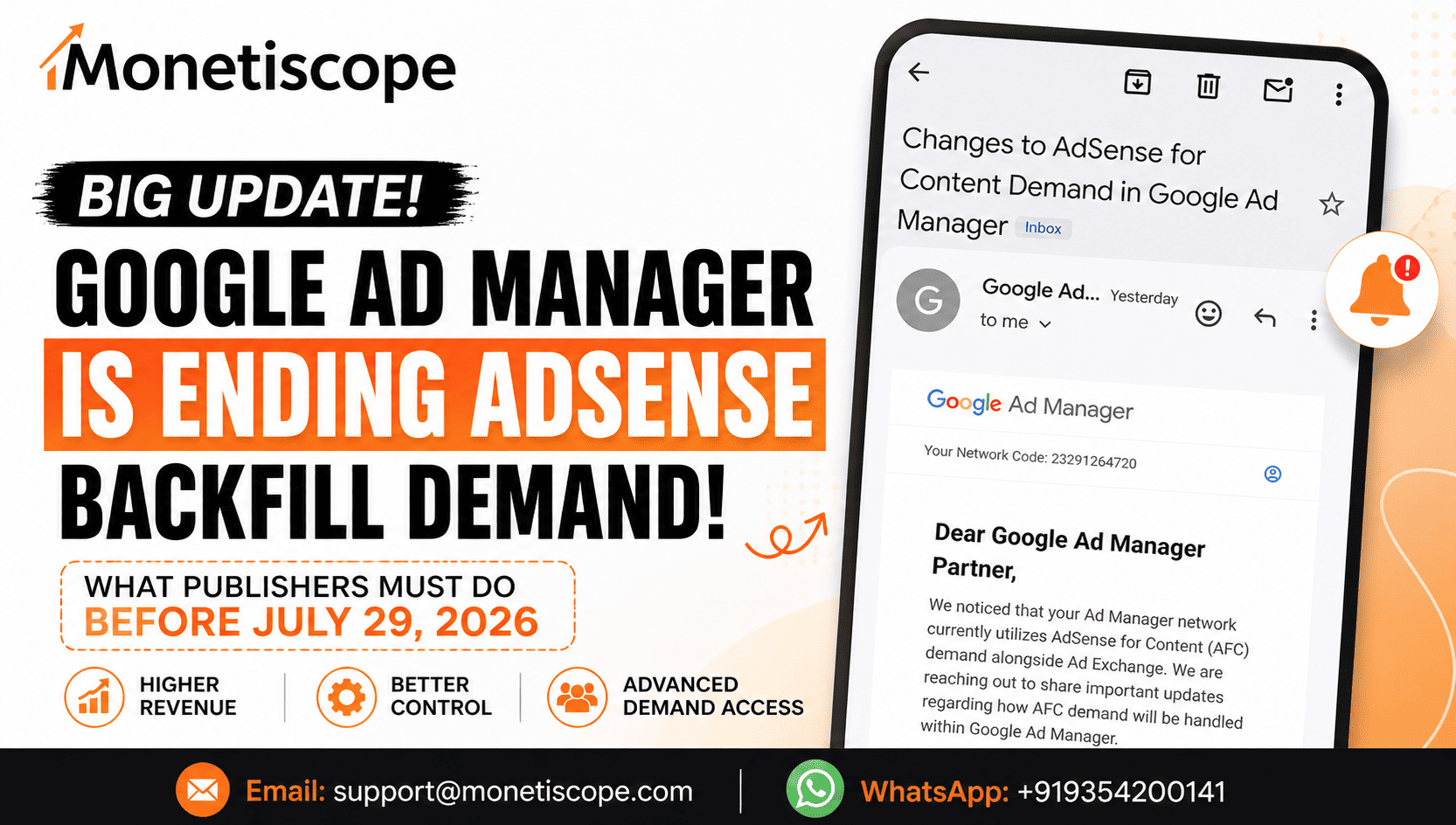
If you’re using Google Ad Manager, this update might feel like a shock.
Honestly, at first, it sounds scary.
But when you dig deeper, it’s actually a pretty solid move by Google.
Still, let’s be real.
If you ignore this, your revenue can literally drop to zero.
Yes, zero.
So let’s break this down in a very human way.
No corporate jargon. No boring explanations.
What Is This Update Actually About?
Google is changing how ads work inside Google Ad Manager.
Earlier, you had two options:
- AdSense (AFC)
- Ad Exchange (AdX)
Now Google is saying:
“Use only AdX.”
That’s it. That’s the update in one line.
This change is part of the Google Ad Manager AdSense Update, and it’s huge.
Wait… Were AdSense and AdX Different?
Here’s something most publishers didn’t know.
AdSense and AdX inside GAM:
Use almost the same advertisers
So when you thought:
- “I have multiple demand sources”
Actually:
- You were using the same demand twice
Kind of funny, right?
So Google decided to clean things up and move everything to:
Google Ad Exchange
Why Google Is Doing This
Let’s be honest.
AdSense inside GAM was always limited.
It didn’t support:
- Private Auctions
- Preferred Deals
- First Look
- Open Bidding
So even if you had traffic,
You weren’t unlocking full revenue potential.
Now with AdX:
- More competition
- Better pricing
- Advanced deals
So yeah, it’s actually an upgrade.
Timeline You Can’t Ignore
Now comes the serious part.
Phase 1 – May 30, 2026
AdX will always win over AdSense.
Even if both are eligible.
AdSense becomes useless in most cases
Phase 2 – July 29, 2026
This is where things get risky.
If your inventory is:
- Only using AdSense
Then:
- No ads will show
- No revenue will come
Yikes, right?
Quick Comparison Table
| Factor | Before Update | After Update |
| Demand Sources | AdSense + AdX | Only AdX |
| Competition | Limited | High |
| Revenue Potential | Medium | Higher |
| Risk Level | Low | High if ignored |
| Setup Complexity | Simple | Slightly advanced |
Google Ad Manager AdSense Update
Let’s say it clearly again.
This Google Ad Manager AdSense Update is forcing everyone to move to AdX.
You don’t have a choice here.
Real Impact on Publishers
If You Already Have AdX
Good news.
You’re ahead of the game.
But still:
- You must clean your setup
- You must check protections
Otherwise, revenue might drop.
If You Depend on AdSense
Not good.
After July:
- Your ads stop
- Your income stops
This is where most people will panic.
Biggest Mistakes Publishers Will Make
Let’s call them out.
1. Ignoring the update
Many will think:
“Ads are running, so I’m fine.”
But slowly:
- AdSense stops working
- Revenue drops
2. Not checking protections
AdX uses different blocking rules.
If too strict:
- Fill rate drops
- Earnings drop
3. Partial migration
Some will:
- Move few ad units
- Forget others
Result:
- Broken monetization
What You Should Do Right Now
Let’s keep it simple.
Step 1: Audit Your Setup
Check:
- Which ad units use AdSense
- Which depend only on it
Step 2: Move to AdX
Make sure:
- All inventory connects to AdX
Step 3: Fix Protections
Align:
- Category blocking
- Advertiser blocking
Step 4: Optimize Revenue
Since you’re upgrading:
- Use better floor prices
- Enable more demand
Myths vs Truths
Myth: AdSense is shutting down
Truth: Only inside GAM
Myth: Revenue will drop
Truth: It can increase
Myth: No action needed
Truth: Action is mandatory
Myth: AdX is complicated
Truth: Slightly, but worth it
Hidden Opportunity Here
Let’s be fair.
This looks like a problem.
But it’s actually a chance to:
- Increase revenue
- Improve setup
- Scale faster
Publishers who adapt early will win.
Others… not so much.
How Monetiscope Helps You
Now honestly, this is where things get tricky.
Understanding is easy.
Execution is hard.
That’s where Monetiscope comes in.
What Monetiscope Does
1. Full GAM Audit
We check everything.
No guesswork.
2. AdX Setup & Optimization
We:
- Improve fill rate
- Increase CPM
3. Protection Optimization
We make sure:
- You don’t block good ads
4. MCM Support
If you manage publishers:
- Smooth migration
- No revenue drop
5. Revenue Growth Strategy
We don’t just fix.
We grow your revenue.
Google Ad Manager AdSense Update
This Google Ad Manager AdSense Update is not optional.
It’s a forced shift.
Adapt or lose revenue.
Final Thoughts
Honestly, this update makes sense.
Google is:
- Simplifying things
- Improving competition
- Giving better tools
But still, it needs action from your side.
And fast.
Google Ad Manager AdSense Update
So yeah, the Google Ad Manager AdSense Update is big.
But if you handle it smartly,
It can actually boost your earnings.
FAQs
1. Will AdSense stop working completely?
No, only inside Google Ad Manager. Outside, it still works normally.
2. What happens if I don’t switch to AdX?
Your ads will stop after July 29, 2026. That means zero revenue.
3. Is AdX better than AdSense?
Yes, it offers more competition and better revenue potential.
4. Do I need technical skills?
Basic knowledge helps. Otherwise, mistakes can happen easily.
5. Can I keep both AdSense and AdX?
Not after this update. AdX will take full priority.
6. What are protections in GAM?
They control which ads show on your site. Too strict settings reduce revenue.
7. How long does migration take?
It depends on your setup. Small sites can do it quickly. Large ones need time.
8. Will my RPM increase?
It can increase if optimized correctly. Otherwise, it may stay the same or drop.
9. What is the biggest risk here?
Ignoring the update and losing monetization completely.
10. Should I take expert help?
Honestly, yes. It saves time, avoids mistakes, and protects your revenue.
If you want, I can also:
- Turn this into a blog page
- Create internal linking strategy
- Or write social media posts for traffic
Just tell me.
Google Ad Exchange
Google Ad Exchange (AdX) is a programmatic advertising marketplace software developed by Google that facilitates real-time buying and selling of digital ad inventory. It connects publishers offering ad space with advertisers through automated auctions, forming a core component of Google’s advertising technology ecosystem.
Key facts
- Developer: Google
- Launch: 2008 (as DoubleClick Ad Exchange)
- Core function: Real-time bidding (RTB) for display, video, and mobile ads
- Integration: Works with Google Ad Manager and Google Ads
- Participants: Publishers, advertisers, ad networks, and demand-side platforms
Function and architecture
AdX operates as the intermediary in online ad auctions. When a user visits a webpage, AdX instantly solicits bids from multiple demand sources for that impression. The winning bid’s creative is displayed to the user—often within milliseconds. The system’s tight integration with Google Ad Manager allows publishers to manage inventory and optimize yield, while advertisers reach audiences through Display & Video 360 or other demand-side platforms.
Evolution and integration
Originally launched as DoubleClick Ad Exchange, the platform became part of the Google Marketing Platform in 2018. Google’s unified ad tech stack—combining AdX, Ad Manager, and Google Ads—streamlined programmatic trading but also raised concerns about market concentration and competitive fairness in digital advertising.
Market significance and scrutiny
AdX has long been one of the largest ad exchanges globally, processing billions of ad transactions daily. Its efficiency and reach helped establish real-time bidding as the industry norm. However, regulatory authorities, including the U.S. Department of Justice, have scrutinized Google’s control over multiple layers of the ad tech supply chain, alleging anticompetitive practices in how auctions were conducted prior to 2019.
Current status
Today, Google positions AdX as part of its transparent, privacy-focused ad ecosystem. It supports open-bidding frameworks, contextual targeting, and compliance with data-protection standards. Despite regulatory challenges, AdX remains central to global digital ad monetization, balancing automation speed with evolving requirements for fairness and user privacy.