

For years, publishers chased rankings.
People optimized titles, stuffed keywords, built backlinks, and prayed for traffic. Sometimes it worked. Sometimes… meh, not really.
But now, things are changing very fast.
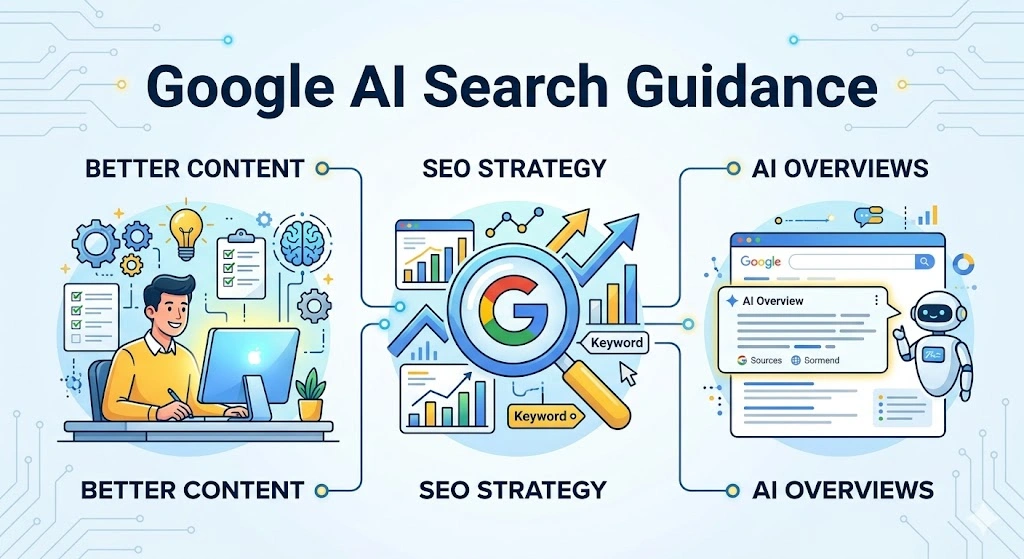
Google has officially shared its new Google AI Search SEO Optimization Guide, and honestly, this is one of the biggest SEO shifts we’ve seen in years.
AI Overviews, AI-generated answers, and Google’s AI Mode are slowly changing how people search online. Instead of clicking ten blue links, users now get direct AI-generated answers at the top.
And yeah, that sounds scary for publishers.
A lot of site owners are already worried about traffic drops, lower CTR, and fewer ad impressions. To be fair, those concerns are valid.
But here’s the interesting part.
Google clearly said you don’t need some magical “AI SEO hack” to survive this update.
Instead, Google wants something much simpler:
Helpful content.
Real expertise.
Better user experience.
And clear answers.
Sounds easy? Well… not exactly.
Because most websites still produce robotic SEO content that feels dead inside. Google’s AI systems are getting smarter at spotting that.
So if you run a blog, tool website, news site, or monetized content platform, this guide matters a lot.
Let’s break everything down in simple language.
What Is Google AI Search SEO ptimization Guide?
Google recently published official guidance explaining how websites can perform better in AI-powered search experiences.
This includes:
- AI Overviews
- AI-generated summaries
- AI Mode in Search
- Enhanced search experiences powered by Gemini
Now here’s the important thing.
Google says AI search still uses many traditional ranking systems.
So no, SEO is not dead.
But the way content gets selected is changing.
Instead of only ranking pages, Google’s AI now tries to extract useful information directly from websites.
That means your content needs to become:
- Easier to understand
- More structured
- More trustworthy
- More experience-driven
Honestly, this is where many websites will fail badly.
Why This Update Matters So Much
Let’s be real.
Most SEO content online is repetitive.
You search for something like:
“How to improve AdSense revenue”
And suddenly every article says:
- Improve SEO
- Increase traffic
- Use better ads
- Optimize speed
Same boring advice everywhere.
Google’s AI systems are now trying to filter out that low-value repetition.
Instead, they want:
- Original insights
- Real-world experience
- Helpful explanations
- Practical solutions
That’s a huge opportunity for websites that actually know their niche.
And for adtech companies like Monetiscope, this is honestly pretty solid news.
Because expertise-based content has a much higher chance of being referenced in AI search.
The Biggest SEO Myth Right Now
A lot of people are selling “AI SEO secrets.”
You’ve probably seen things like:
- GEO optimization
- AI schema hacks
- llms.txt tricks
- Hidden AI prompts
- AI crawler manipulation
Yikes.
Google basically confirmed most of that stuff isn’t necessary.
You do NOT need:
- Special AI schema
- Hidden AI tags
- Separate AI websites
- Keyword stuffing for AI
Instead, Google keeps repeating one thing:
Create useful content for people first.
Simple… but powerful.
Traditional SEO Still Matters
This part surprised many people.
Google clearly explained that AI search still depends heavily on existing ranking systems.
So things like these still matter:
- Technical SEO
- Website speed
- Mobile optimization
- Internal linking
- Helpful content
- Backlinks
- User experience
In short:
Good SEO still wins.
But now there’s an extra layer.
Your content must also be easy for AI systems to understand and extract.
That changes content strategy a lot.
How AI Search Actually Reads Your Website
This is where things get interesting.
Google’s AI doesn’t just rank pages anymore.
It scans content for:
- Direct answers
- Key explanations
- Structured information
- Trust signals
- Expertise indicators
That’s why many generic articles may lose visibility.
Meanwhile, practical and experience-based content could gain more exposure.
For example:
A generic article saying:
“Improve ad placements for better revenue”
…is weak.
But an article saying:
“We improved publisher RPM by 37% after moving sticky units below navigation”
…has actual value.
AI systems love specificity.
What Type of Content Will Win in AI Search?
Here’s the truth.
The future belongs to websites that actually know what they’re talking about.
Not websites mass-producing AI garbage.
Google’s systems now reward:
- First-hand experience
- Practical insights
- Real examples
- Detailed explanations
- Strong topical authority
That means publishers should stop writing shallow 600-word articles.
Depth matters more now.
Content Types That May Perform Better
| Content Type | AI Search Potential |
|---|---|
| Case studies | Very High |
| Tutorials | High |
| Comparison articles | High |
| FAQ-rich pages | Very High |
| Opinion-based expert content | High |
| Thin affiliate content | Low |
| Generic AI-written blogs | Very Low |
Honestly, this shift was coming anyway.
Users are tired of low-quality content.
Why FAQs Are Suddenly Very Important
AI systems love FAQ sections.
Why?
Because FAQs:
- Give direct answers
- Improve clarity
- Help AI extract information quickly
- Match conversational search queries
For example:
Instead of writing:
“Ad viewability affects monetization.”
You should also answer:
“What is ad viewability?”
“How does viewability increase CPM?”
Small difference. Huge impact.
AI Overviews Could Hurt Traffic
Now let’s talk about the scary part.
AI Overviews may reduce clicks for many websites.
Because users might get answers directly inside Google.
That means:
- Lower CTR
- Fewer pageviews
- Less ad inventory
- Revenue pressure for publishers
And yeah, this is a serious issue.
Especially for websites surviving mainly on informational traffic.
But there’s another side too.
Websites that become trusted AI citation sources may still receive:
- Better-quality visitors
- Stronger authority
- Higher trust
- More branded searches
So this isn’t only bad news.
It’s more like a huge transition phase.
What Publishers Should Do Right Now
Honestly, waiting is a bad strategy.
Publishers should adapt early.
Here’s what smart websites are already doing.
1. Write More Experience-Based Content
This is probably the biggest opportunity right now.
Instead of generic SEO blogs, publish:
- Real case studies
- Revenue experiments
- Optimization breakdowns
- Before vs after results
Example:
“How We Increased Ad Viewability by 42% on a Job Website”
That type of content performs much better in AI search.
Because it contains unique information.
2. Improve Content Readability
AI systems prefer clean and understandable content.
So avoid:
- Huge paragraphs
- Complex wording
- Over-optimization
Instead:
- Use headings
- Use tables
- Add short paragraphs
- Answer questions directly
Simple content usually wins.
3. Build Topic Authority
Random blogging doesn’t work anymore.
You need topical depth.
For example, if your niche is ad monetization, create clusters around:
- AdX optimization
- Ads.txt
- Viewability
- Sticky ads
- Header bidding
- Video monetization
- Google AdSense
- Publisher SEO
This helps Google understand your expertise.
4. Add Real Insights
This matters a lot now.
Google wants original value.
So instead of:
“Sticky ads improve revenue”
Explain:
- Where sticky ads work best
- Which layouts hurt UX
- Mobile vs desktop performance
- Real RPM differences
Specificity builds trust.
5. Strengthen Technical SEO
AI search still depends on strong technical foundations.
So publishers should improve:
- Core Web Vitals
- Crawlability
- Internal links
- Schema markup
- Mobile usability
- Indexing quality
Without technical SEO, content may struggle anyway.
Myth vs Truth About AI SEO
| Myth | Truth |
| SEO is dead | SEO still matters a lot |
| AI content automatically ranks | Low-quality AI content often fails |
| You need secret AI hacks | Helpful content matters more |
| AI Overviews destroy all publishers | Strong brands can still grow |
| Keywords don’t matter anymore | Search intent still matters heavily |
Why Human Content Matters More Than Ever
Funny enough, AI search is making human content more important.
Because AI systems are getting better at detecting:
- Repetition
- Generic advice
- Low-value wording
- Content without expertise
So weirdly, the best way to survive AI search is to sound more human.
Not more robotic.
That’s why:
- Personal experiences
- Opinions
- Case studies
- Natural writing
…all matter more now.
How Monetiscope Can Help Publishers Adapt
At Monetiscope, we work closely with web publishers, monetized content sites, and adtech workflows daily.
And honestly, we’re seeing this shift happen in real-time.
Many publishers still focus only on traffic numbers.
But the future is about:
- Content quality
- User experience
- Monetization efficiency
- Search trust signals
Our team helps publishers improve:
- Ad placements
- Viewability
- Monetization structure
- SEO-friendly monetization
- User experience balance
- Ad implementation workflows
We also built tools like AdX Ad Inserter to simplify monetization setups without heavy technical dependency.
Because let’s be honest.
Most publishers lose revenue due to poor implementation and weak optimization, not just traffic issues.
As AI search evolves, publishers will need smarter strategies, not just more articles.
And that’s exactly where practical monetization expertise becomes valuable.
The Future of SEO Looks Different
SEO isn’t disappearing.
It’s evolving.
Traffic patterns may change.
CTR may change.
Content formats may change.
But quality still wins.
Actually, quality matters more now than ever before.
The websites that survive this AI transition will be the ones that:
- Build trust
- Share expertise
- Publish unique insights
- Focus on user value
Not the ones mass-producing shallow content every day.
That era is slowly fading.
Final Thoughts
Google’s AI Optimization Guide sends a very clear message.
There’s no shortcut anymore.
No secret AI trick.
No magical optimization hack.
No hidden prompt strategy.
Helpful content still matters most.
But now publishers must create content that:
- Feels human
- Solves problems
- Shows expertise
- Provides original value
Honestly, that’s probably better for the internet anyway.
Because users deserve better content.
And publishers who genuinely help users may finally stand out again.
FAQs
What is Google’s AI Optimization Guide?
Google’s AI Optimization Guide explains how websites can perform better in AI-powered search experiences like AI Overviews and AI Mode.
Is SEO dead because of AI search?
No, not at all. Traditional SEO still matters heavily. However, content quality and expertise matter much more now.
Does AI-generated content rank on Google?
It can, but low-quality AI spam usually struggles. Google prioritizes helpful and experience-based content.
What type of content performs best in AI search?
Case studies, tutorials, expert insights, FAQs, and practical guides generally perform much better.
Do I need special AI schema for ranking?
No. Google clearly mentioned that special AI-specific schema is not required.
Can AI Overviews reduce website traffic?
Yes, some publishers may see lower click-through rates because users get answers directly inside search results.
How can publishers adapt to AI search?
Publishers should focus on:
- Helpful content
- Better readability
- Real expertise
- Technical SEO
- Strong topic authority
Why are FAQs important for AI SEO?
FAQs provide direct answers. This helps AI systems understand and extract information more easily.
How does Monetiscope help publishers?
Monetiscope helps publishers improve monetization performance, ad placements, viewability, implementation quality, and overall publisher workflows.
What is the future of SEO after AI search?
SEO will become more expertise-driven. Human-focused, experience-rich content will likely outperform generic content.