
If your mobile app has started getting good traffic, you’ve probably heard people talking about an AdX Managed Account for Mobile App Monetization. Many developers switch to AdX after reaching a certain growth stage because it usually offers better competition among advertisers and higher earning potential.
But here’s the thing. Google doesn’t simply approve every app for AdX. There are certain quality standards, traffic expectations, and business requirements that publishers need to meet.
In this guide, we’ll explain everything in simple language. You’ll learn what an AdX Managed Account is, how it’s different from AdMob, who can apply, and how the Monetiscope team helps developers throughout the process.
What is an AdX Managed Account?
An AdX Managed Account is a Google Ad Exchange account provided through an authorized Google partner. Instead of managing your inventory only through AdMob, your app gets access to Google’s premium advertising marketplace.
Think of it this way.
AdMob works great for most apps, especially new ones. However, once your app grows, advertisers begin competing for your inventory through AdX. More competition often leads to better CPMs and higher revenue.
This doesn’t mean every app should move to AdX immediately. It works best for apps that already have strong traffic and consistent user engagement.
AdX vs AdMob: What’s the Difference?
Many developers assume both platforms are the same. They aren’t.
| Feature | AdMob | Google AdX |
| Best For | Small and medium apps | Large and growing apps |
| Advertiser Competition | Standard | Premium marketplace |
| Revenue Potential | Good | Usually higher |
| Approval | Easy | Strict eligibility |
| Account Type | Self-service | Managed through approved partners |
| Optimization | Limited | Advanced optimization options |
AdMob is often the first step for app monetization.
Google AdX becomes valuable when your app starts generating enough impressions to attract premium advertisers.
Requirements to Get Google AdX Approval for App Monetization
Google doesn’t publicly publish a fixed checklist. However, most approved apps generally meet several important conditions.
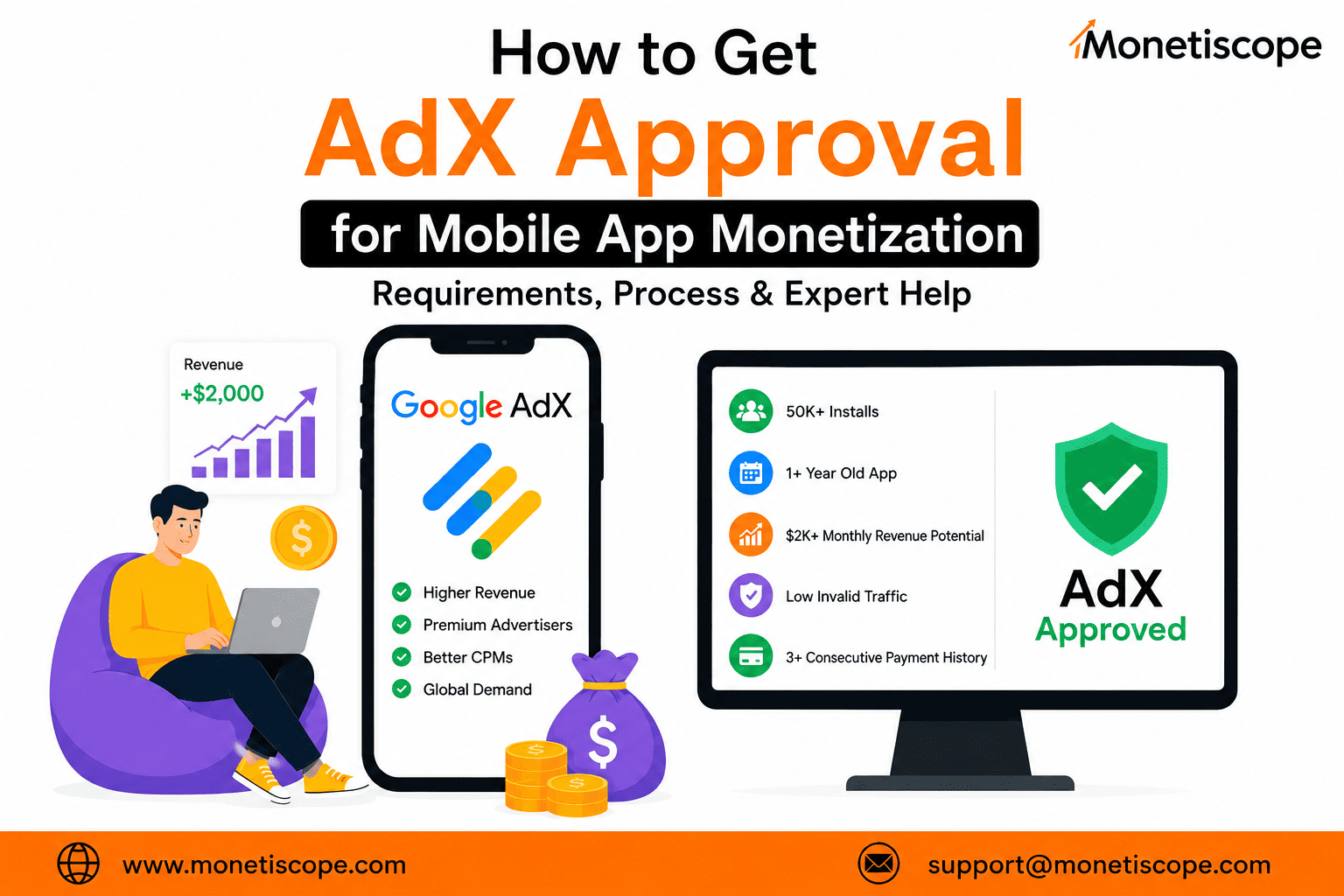
1. At Least 50,000+ App Installs
Apps with a solid install base usually have better chances of approval.
The exact number isn’t officially confirmed by Google. Still, having over 50,000 installs makes your application much stronger.
2. App Should Be More Than One Year Old
A mature app shows stability.
Google and AdX partners often prefer apps that have been active for at least one year because they already have user history and consistent performance.
3. Monthly Revenue Potential Around $2,000 or More
Revenue matters because AdX works best for high-volume inventory.
If your app already generates healthy traffic and has the potential to earn around $2,000 per month or more, it becomes a stronger candidate for approval.
4. Low Invalid Traffic
This is one of the biggest factors.
If your app receives fake clicks, bot traffic, or suspicious activity, approval becomes difficult.
Google values clean and genuine user engagement. Even after approval, maintaining low invalid traffic remains important.
5. At Least Three Consecutive Payment Histories
Many managed account providers also look for a stable earning record.
If you’ve already received at least three consecutive payments from your existing monetization setup, it helps demonstrate that your app consistently generates revenue.
How to Apply for an AdX Managed Account
Honestly, this part confuses many developers.
You can’t simply create a Google AdX account the same way you create an AdMob account.
Instead, most publishers work with an authorized Google monetization partner that manages AdX inventory.
The general process looks like this:
- Share your app details.
- The partner reviews your traffic quality.
- Revenue and policy compliance are evaluated.
- Your eligibility is verified.
- Documentation is completed.
- AdX setup and integration begin after approval.
The review process may take anywhere from a few days to a few weeks depending on your app and documentation.
Why Many Apps Don’t Get Approved
Sometimes developers meet the install requirement but still get rejected.
Common reasons include:
- Invalid or low-quality traffic.
- Policy violations.
- Poor app engagement.
- Low revenue potential.
- Incomplete monetization history.
- Poor ad implementation.
Fixing these issues before applying can significantly improve your chances.
How Monetiscope Helps You Get AdX Approval
Applying alone can feel confusing, especially if you’re unsure whether your app qualifies.
That’s where the Monetiscope team comes in.
Our experts first review your app instead of submitting applications blindly. We analyze traffic quality, monetization history, policy compliance, and revenue potential.
If improvements are needed, we guide you step by step before moving forward.
Once your app becomes eligible, our team assists with the complete onboarding process, AdX account setup, inventory optimization, and monetization strategy.
Even after approval, we continue monitoring performance to help improve fill rates, increase CPMs, and maximize long-term revenue.
Instead of guessing what Google expects, you get guidance from professionals who work with app monetization every day.
Is an AdX Managed Account Right for Your App?
To be fair, not every app needs AdX.
If your app is still new, AdMob remains a great starting point.
However, if you’ve built a quality app with strong installs, stable traffic, and consistent earnings, an AdX Managed Account for Mobile App Monetization could help unlock better advertiser demand and higher revenue opportunities.
The key is making sure your app is actually ready before applying.
Frequently Asked Questions (FAQs)
1. What is an AdX Managed Account for Mobile App Monetization?
An AdX Managed Account for Mobile App Monetization is a Google Ad Exchange account provided through an authorized Google monetization partner. It gives eligible apps access to premium advertiser demand, which can help increase CPMs and overall ad revenue.
2. What is the difference between AdMob and Google AdX?
AdMob is designed for developers of all sizes and is easy to set up. Google AdX is intended for larger publishers with high-quality traffic and is available through approved partners. AdX generally offers more advertiser competition and advanced monetization features.
3. What are the requirements to get an AdX Managed Account?
While Google doesn’t publish official eligibility criteria, most approved apps typically have:
- 50,000+ installs
- An app that’s at least one year old
- Around $2,000+ monthly revenue potential
- Low invalid traffic
- At least three consecutive payment histories
- Good policy compliance
Meeting these doesn’t guarantee approval, but it can improve your chances.
4. Can a new mobile app get Google AdX approval?
Usually, no. Most new apps don’t have enough traffic or monetization history. It’s better to grow your user base with AdMob first and then apply for AdX once your app becomes eligible.
5. How do I apply for an AdX Managed Account?
You typically apply through an authorized Google monetization partner. The partner reviews your app, checks eligibility, verifies traffic quality, and helps with the onboarding process if your app qualifies.
6. How long does the AdX approval process take?
The approval time varies depending on your app’s quality, documentation, and eligibility. In many cases, it can take anywhere from a few days to several weeks.
7. Why is my app not eligible for Google AdX?
Some common reasons include:
- Low-quality or invalid traffic
- Policy violations
- Low revenue potential
- Insufficient app installs
- Poor user engagement
- Limited monetization history
Improving these areas can increase your chances of approval.
8. Does Google guarantee higher revenue with AdX?
No. Google doesn’t guarantee higher earnings. However, because AdX has access to premium advertisers and real-time bidding, many eligible apps experience better CPMs and improved revenue compared to AdMob alone.